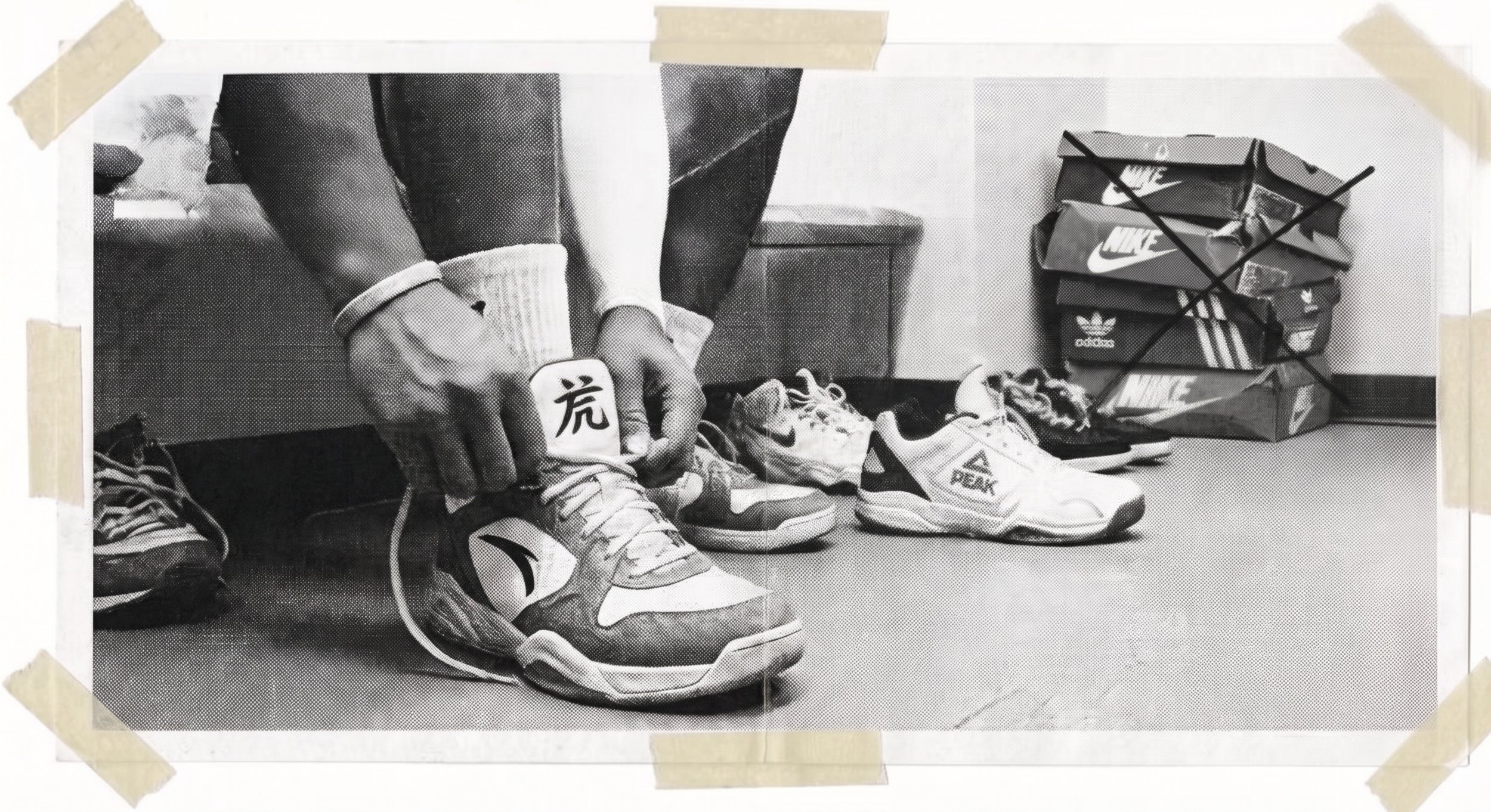
I play a lot of basketball. Multiple times a week I find myself in a slightly damp, dingy sports hall, running up and down the court, chasing a ball amongst sweaty, tall men who don’t give each other an inch.
The games get intense, and the verbal jousting begins. Trash talk has always been a part of the game. The stickles, jabs, and prods are to be expected, but compliments are rare between men during basketball scrimmages.
That embargo on kind words can be broken, however.
Just last week, instead of the usual taunts, many players were unexpectedly complimentary of me. I’d love to say it was because of my sublime play, but the bruising giants around me were too busy admiring my shoes. In their obsession over what is on their feet, basketball players could rival any New York fashionista.
What drew their admiration was my new pair of Way of Wade All City 13s, from the signature line of retired NBA legend Dwyane Wade. Snakeskin, with pink accents and a sleek, futuristic design, they stood out. But what really had the fellas talking was the fact that they were created by Dwyane Wade in collaboration with the Chinese sportswear company Li-Ning.
The landscape of basketball shoes is changing. China is making a concerted effort to play a major role in a business once so firmly dominated by the West.
It started with canvas
Converse created the iconic canvas and rubber Chuck Taylor All Star in 1917. It was the first mass produced basketball shoe in North America, designed to fill a gap in the market caused by the ever increasing popularity of the sport. Converse went on to create a leather version of the All Star for added durability, before introducing the Pro Leather in 1976 which became a game-changer for the sport and ensured Converse’s continued domination of the basketball shoe market for the next decade.
Basketball legends Larry Bird and Magic Johnson were still lacing up Converse Pro Leathers in the early 1980s, the rivalry between them as bright as the shoes on their feet.
Then came a seismic shift. In 1985, the Nike Air Jordan 1 lifted off and a revolution in basketball shoes began. A shoe that the company introduced with a modest goal of $3 million in sales in the first three years, earned over $120 million in just one year, according to figures later cited by former Nike executive Sonny Vaccaro.
Nike’s ascendancy in the basketball market had begun.
Through the 1990s and 2000s the basketball shoe palette exploded and sponsorship with NBA star players became the norm. Nike continued to gain market share with offerings that moved away from traditional designs, including the alien-looking Air Foamposites. These technologically innovative shoes, worn by NBA All-Star Penny Hardaway, featured a seamless, durable, moulded plastic upper that offered improved performance and a sleek new design.
But other western companies were also entering the fray for market share.
AND1, a company started as a graduate school project by three students at the University of Pennsylvania’s Wharton School, entered the market in the mid 1990s and became famous through gritty streetball highlight reels of New York’s famous Rucker Park. By 2001 AND1 was the second largest basketball brand in the U.S. after Nike, with models such as the Tai Chi, which gained massive fame after NBA All-Star Player Vince Carter wore them in the 2000 NBA Dunk Contest.
Reebok responded to the challenge by developing a shoe series for NBA Superstar Allen Iverson. The Reebok Answer line introduced a new technology known as DMX 10 which provided a series of interconnected air pods that moved back and forth to provide adjustable cushioning under the foot. It became a best seller as Iverson continued to capture the public’s attention with controversial behaviour both on and off the court.
The 2010s saw a further expansion of basketball shoe offerings by western companies. While Nike built out lines for NBA superstars LeBron James and Kevin Durant, Under Armour arrived on the market with a superstar of their own—legendary Golden State Warriors point guard Stephen Curry. Adidas chased with Boost cushioning and a revival of its old stripes, securing sponsorship deals with NBA All-Stars Derrick Rose and James Harden.
However, even with these other competitors on the scene (and their exclusive sponsorships with superstars of the era), by the mid 2010s Nike and its subsidiary Jordan Brand together held overwhelming control of performance basketball in the United States, regularly clocking more than four out of every five dollars in the category according to NPD and contemporaneous reporting.
One 2014 snapshot by Forbes industry analyst Matt Powell had Nike Basketball and Jordan Brand tallying roughly 96 percent of the U.S. basketball performance market. Later trade coverage and NPD analysis still showed Nike and Jordan above 80 percent going into 2020. For a while that felt unbreakable.
Then a different current gathered strength across the Pacific.
The first big defection
In 2012, Dwyane Wade walked away from his sponsorship deal with Jordan Brand and signed with Li-Ning, a sportswear giant based in Beijing. It was not just a regional deal for the Chinese market. It was the birth of Way of Wade, a full signature line backed by a Chinese company and fronted by one of the NBA’s premier guards in the prime of his career. Wade later doubled down with a lifetime agreement in 2018, a step that shocked the industry.
The timing was not accidental. Basketball’s base in China is enormous.
NBA league and research figures over the past decade have consistently framed the scale: hundreds of millions of Chinese play or follow the sport, and NBA content has reached staggering audiences through the Chinese streaming giant Tencent. An NBA release statement in 2019 put viewership in China at 490 million people in a single season on Tencent platforms, with a record 21 million watching Game 6 of the 2019 Finals on digital platforms alone. Other industry studies around the same period cite roughly 300 million people in China playing or following basketball and as many as 640 to 800 million engaging with some NBA content in peak seasons.
The precise totals fluctuate by methodology, but the massive market share and revenues are clear.
For years, the passion of the Chinese for basketball created huge revenues for Western basketball shoe companies. Imports dominated the Chinese market, as local brands were either budget options or distant also-rans. Wade’s choice cracked open the door to a new era and has allowed a different story to start to take shape.
From copycats to contenders
Li-Ning has continued expanding and building out its basketball shoe offerings. Anta, another large Chinese sportswear brand, along with 361°, Peak, and Rigorer have also joined the push by Chinese companies to compete in the international basketball shoe market.
Their strategy has been blunt but effective. Sign credible NBA names for global legitimacy, saturate the domestic ecosystem, and pour money into cushioning, plates, foams, and fits—the technical elements that protect joints and return energy. Then ship their products around the world and provide an innovative alternative to the western brands that had long dominated the international market.
Anta’s playbook is the clearest tell. The company signed Golden State Warriors sharpshooter Klay Thompson in 2014, then added Gordon Hayward, and in 2023 brought in superstar Kyrie Irving not only as a signature athlete, but as a creative lead for its basketball push. His Kai line began rolling out in 2024, and Anta has since started using his portfolio to seed other NBA endorsements.
Rigorer took a similar path, although it arrived on the international scene a bit later than some of its fellow domestic competitors. In 2023 it made Austin Reaves, the Lakers’ breakout guard, its first major NBA endorser with a signature shoe, the AR1. The debut colorways sold out in minutes on KICKSCREW, a major online sneaker marketplace, providing a tidy litmus test for Western demand. The brand then added Brandin Podziemski as it leaned into the Lakers-boosted halo around Austin Reaves.
361° went star-hunting and landed the biggest fish available in 2023: Nikola Jokić, the reigning MVP, who unveiled his new JOKER 1 at a special event in December 2024 at Denver’s Ball Arena. Aaron Gordon, a fellow Denver Nugget and dunk star, also went on to sign with the company and broaden the brand’s on-court footprint.
By the 2024-25 season, Chinese brands were no longer curios in the signature ecosystem. A current list of men’s and women’s signatures showed superstars Klay Thompson and Kyrie Irving with Anta, Jimmy Butler with Li-Ning, Nikola Jokić, Aaron Gordon, and Spencer Dinwiddie with 361°, and Austin Reaves and Brandin Podziemski with Rigorer. In a universe with little more than two dozen active signatures, roughly a third of the roster spots are tied to Chinese labels.
And while signature share is not sales share, it is a strong proxy for cultural presence and on-court visibility.
What changed in the Chinese shoes?
Three major changes occurred. First, the engineering caught up to the west. Li-Ning’s high performance, cushioning technology, Boom Foam, became the standard midsole across Way of Wade and other lines. Anta built proprietary nitrogen foams and lateral containment systems that tested well in independent performance reviews. 361° pushed torsion plates (rigid supports that prevent the shoe from twisting and promote midfoot stability) that helped their star signature Jokić continue to shine as one of the best players in the NBA.
None of these companies were inventing foam, but they were iterating quickly, tuning last shapes (the three-dimensional molds that determine the fit, shape and silhouette of the shoe) for guards as well as big body types, and hitting price points under the top Nike and Jordan Brand models.
Increased sales followed. According to the company’s annual results, Anta’s revenue crossed 70.8 billion Yuan (circa 10.15 billion U.S. Dollars) in 2024, up 13.6 percent year on year, with the company repeatedly described as China’s top sportswear brand by market share in recent industry coverage.
Euromonitor International, a leading global market research company, reported that Anta was leading the Chinese domestic sportswear field in 2024 with an approximate 23 percent share, followed by Li-Ning with a 10 percent share of the market. While those are whole-category numbers, not basketball only, they do capture the home-market power base behind the international push.
Finally, the global landscape also shifted. Euromonitor tracked Anta’s worldwide sportswear market share rising from roughly 2.9 percent in 2022 to 3.4 percent in 2024, while Nike’s dipped; a small but telling expansion given the sector’s size. At the same time, U.S. basketball-shoe revenue softened overall as athleisure, sporty clothing worn as everyday wear, ate into performance categories, which made any gains at the edge more visible.
If you play in the UK, you have noticed it. A few years ago, spotting a pair of Antas or Way of Wades in a London rec run was rare. Now the odds are better every month. UK trade data show a broad surge in athletic-footwear imports post-2020, and while it is impossible to isolate basketball shoe figures within the public trade data, what you see in gyms matches what you see on shelves. The shoes are here. The price points are sharp. The performance is real.
None of this means Nike and Adidas are done. Far from it. Nike and Jordan Brand still dominate U.S. performance basketball by revenue, even as the broader category has shrunk from its mid-2010s peak. And the next front for Chinese companies is physical presence in the West. Anta’s first U.S. flagship is slated for Beverly Hills, a symbolic step meant to translate years of on-court sightings into everyday retail recognition.
Why NBA players are crossing over
Money obviously matters in the signature deals made by NBA star players. But so does control. Kyrie Irving’s Anta deal made him a creative lead, with the latitude to build his sub-line and bring in other athletes. Austin Reaves joined Rigorer early and got an equity-style partnership with the company as his profile rose with the Los Angeles Lakers. Jimmy Butler’s Li-Ning line, JB, gives him significant control over the direction of the line that bears his name.
These contracts read differently from the old template, where a star collected a check and modelled in a campaign, but had very little say in the design and marketing of the shoe, let alone an ownership share.
There is also the story of fit. Chinese companies have shown a willingness to work very closely with their star signatures to create a shoe basically custom-made to fit their needs. Nikola Jokić needs a platform stable enough for a 7-footer who plays every angle on the floor. Guards who live in the pick-and-roll want shoes that “ride low” (sit close to the floor for stability), “bite” (provide grip) on stop-and-go movements, and do not “mush out” (lose firmness) after two weeks. In that niche, models like Anta’s KT series (in collaboration with NBA star Klay Thompson) and its Kai Line (created in partnership with Kyrie Irving), as well as the latest Way of Wade entries, have won loyalists game by game.
Finally, there is the fan feedback loop. When the Rigorer AR1 “Ice Cream” and “Stars and Stripes” sold out within minutes in 2023 drops, it did more than move units. It signaled that even a mid-tier NBA name like Austin Reeves could move product with the right storytelling and price. The sell-through gave retailers and blogs a reason to keep covering the wave.
So where is “market share of Chinese basketball shoes” today?
There is no single public data set that breaks out global basketball-footwear sales by brand origin in a way analysts would accept without caveat. Here is what can be said with confidence.
In the United States, Nike and Jordan Brand still dominate performance basketball revenue, with the major market research firm NPD Group placing them in the mid-80s percent share range as recently as 2019 and trade coverage holding them above 80 percent in 2020. That leaves the remainder to Adidas, Under Armour, Puma, New Balance, and a cluster that now includes Anta, Li-Ning, 361°, Peak and Rigorer.
In other words, Chinese brands are still single-digit by sales in the U.S. performance basketball category, even as their on-court visibility has jumped.
Globally, the clearer indicator is signature presence and domestic dominance. In 2025, roughly a third of active NBA and WNBA signature lines were tied to Chinese companies. Inside China, Anta and Li-Ning now control meaningful shares of the overall sportswear market, with Anta around 23 percent domestically and Li-Ning just over 10 percent according to Euromonitor reports. That foundation is what funds the basketball push abroad.
Chinese brands still trail very significantly in U.S. sales, but now lead in their home market, and have reached parity on star power in the signature arena.
What happens next
The next few years will decide if this surge is a blip or a reset. For the Chinese companies, the task is to continue to increase international consumer trust in their products and create a strong retail presence in North America and Europe. Anta’s planned U.S. flagship store is a signal of intent. If it performs, expect lots more Chinese sportswear companies to open retail stores in the West, along with more mid-tier NBA player signings and careful distribution. You can also expect more tech stories from Chinese companies, because that is one of the main leverage points for these companies to continue to shine in the future.
On the Western side, companies like Nike and Adidas still have the infrastructure, the heritage lines, and the budgets. But they also have a structural challenge. The basketball category is smaller than it was a decade ago. Athleisure ate into market share and COVID rewired habits. NPD and fellow market research company Circana data across 2024-2025 show the category down again year over year, even as fashion-leaning basketball silhouettes flicker back to life. That environment rewards the brands that can make fewer, better products and sell them with precision rather than flooding the wholesale market.
It seems a monopoly that lasted for a generation has started to fray. Not because nostalgia has disappeared, but because the performance of Chinese companies has improved by leaps and bound.
The last word
Basketball’s future will still be written in American arenas. But the future of basketball shoes no longer will be – at least not exclusively. The West invented the template for basketball shoes, but China has now turned the choice of what to wear on the court into a real contest.
On any given night, the best NBA center alive may be in 361°. A Finals closer may be in Anta. A two-way wing might lace up in Way of Wades. A role player could sell out a Rigorer drop in five minutes. None of that was imaginable a decade ago. Now it is the new normal.
If you are buying, here is the practical calculus: Nike and Jordan still hold the crown for breadth and heritage; Chinese labels are competing on price and performance and winning more often than nostalgic memory would like to admit.